If you’ve spent any time researching car seats, you’ll know that ISOFIX has become synonymous with safety. The message is consistent across retailers, parenting forums and manufacturer marketing: ISOFIX is better than seatbelt installation, and a seat with ISOFIX is a seat you can trust.
So when parents discover that the Multimac doesn’t use ISOFIX, the reaction is understandable. It sounds like a compromise. It isn’t, and understanding why requires a short detour into what ISOFIX actually is and what problem it was designed to solve.
What ISOFIX is for
ISOFIX was developed in the 1990s to solve a specific problem: incorrect installation. Studies consistently found that a large proportion of car seats were being fitted wrongly, either with the seatbelt routed incorrectly, the seat not secured tightly enough, or both. A standardised rigid connection directly to the car’s structure removed a significant source of human error.
That’s what ISOFIX does. It reduces the margin for installation error for a single seat in a designated position. It works well for that purpose.
However, ISOFIX points are only certified up to a certain strength, which means that child seats for children over 6 may locate using the ISOFIX points, but have to use the adult belts as well to support the full weight of the child.
So there is no way ISOFIX can support a multiple child seat capable of carrying four 12-year-olds.
The ISOFIX constraint most families never notice
Standard ISOFIX anchor points exist on the two outer rear seats of most cars. The middle rear seat doesn’t have them. It’s not an oversight or a cost-saving measure. That’s simply how the regulatory framework works. Two ISOFIX points, two outer seats.
For a family with one or two children, this is fine. Both children use the outer seats, both have ISOFIX, everything is straightforward.
For a family with three children, the middle position creates an immediate problem. Any seat going in the middle has to be belt-installed rather than ISOFIX-anchored, because the anchor point simply isn’t there. And then there’s the width issue: two ISOFIX seats on the outer positions take up enough lateral space that fitting a third seat in the middle becomes a tight, sometimes impossible exercise depending on the car.
The Multimac solves this by not using ISOFIX at all.
How the Multimac actually anchors
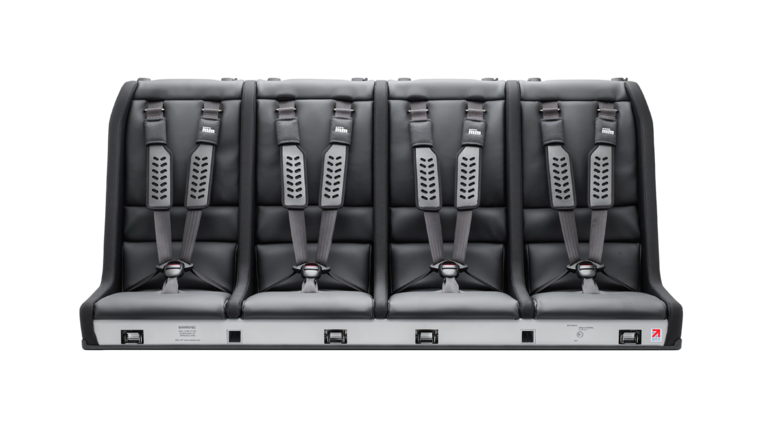
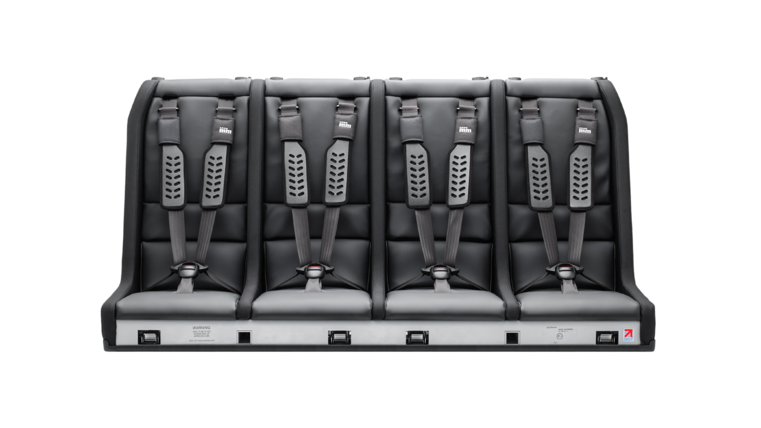
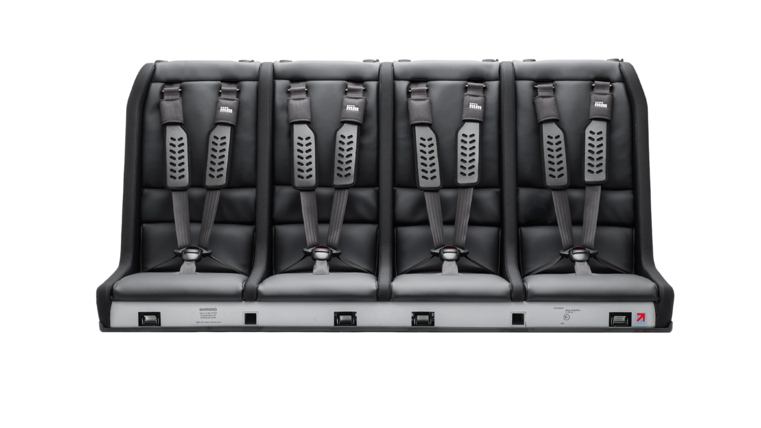
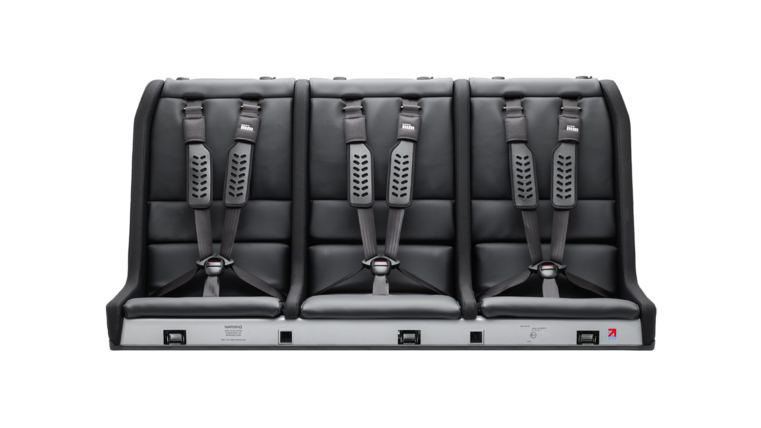
Rather than attaching to the seat-specific ISOFIX points, the Multimac connects directly to the car’s chassis via two tether straps, bolted by a trained installer to the existing, certified-strength mounting points for the adult seatbelt buckles. Instead of using two fixed points on individual seat positions, the connection goes straight into the structural frame of the car.
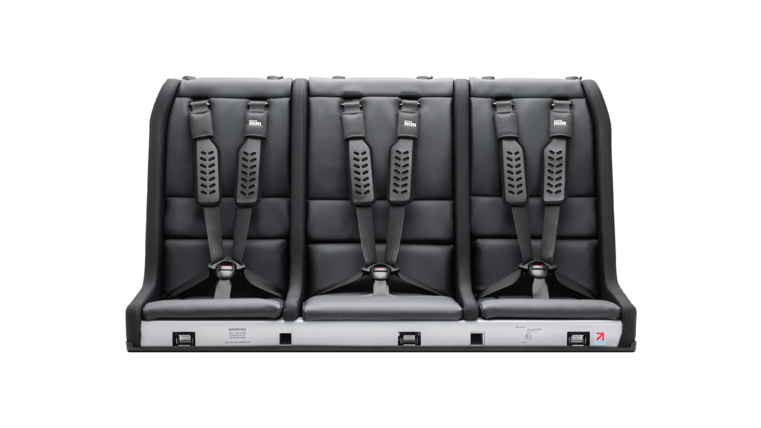
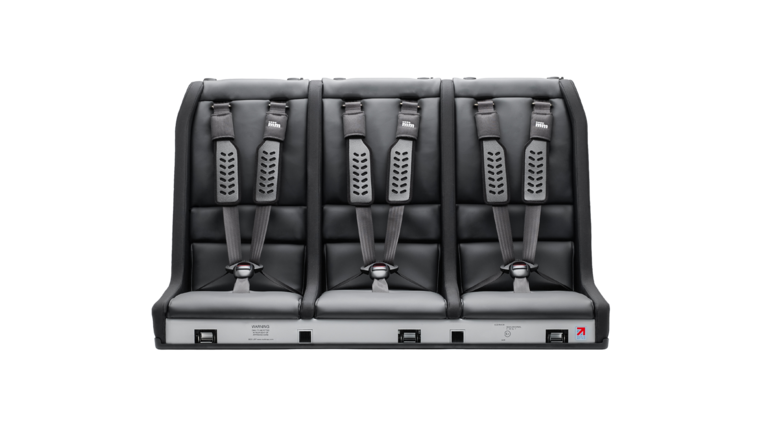
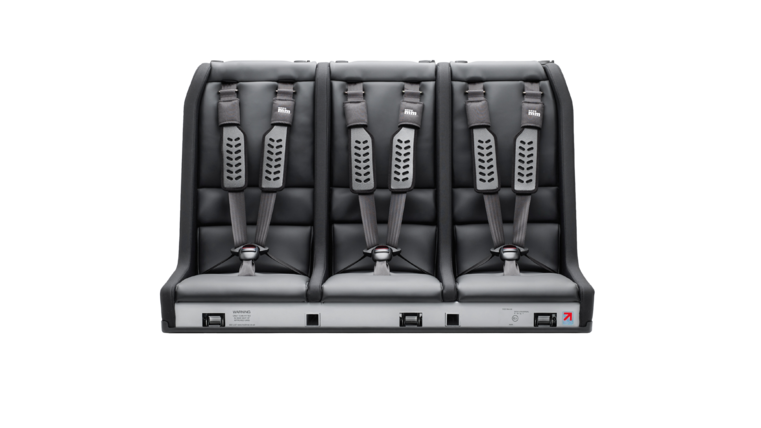
The result is a seat that spans the full width of the rear bench without being constrained by where the ISOFIX points happen to be. All three or four children sit within the same frame, each in their own individually harnessed position, with the whole unit anchored to the car beneath them.
The chassis-mount approach wasn’t a fallback. Multimac chose it specifically because ISOFIX was never going to work for a seat designed to carry four 12-year-olds.
Is it as safe?
Yes. The Multimac is certified to R129 and ECE 44-04, the same European safety standards that govern ISOFIX-equipped seats. Certification under these standards requires the seat to pass independent crash testing for frontal, rear and side impacts. The seat tested is the actual seat customers buy and install, not a theoretical prototype.
ISOFIX is one method of achieving a secure connection between a car seat and a vehicle. The Multimac’s chassis-anchoring system is another. Both are assessed against the same safety standards. The difference is that the chassis-mount approach works for much greater loadings.
What professional installation adds
One of the practical benefits of ISOFIX is that it’s hard to fit incorrectly. The clips either engage or they don’t. This matters because most parents fit their own car seats without professional help.
The Multimac tether straps are installed by a trained fitter who locates the correct chassis anchor points for your specific vehicle and bolts the tether straps correctly before fitting the Multimac.
However, you can then remove and refit the Multimac yourself. There is only one route for the tether straps into the Multimac, so there’s no possibility of incorrect fitting.
The honest answer to “is it safe without ISOFIX?”
The question assumes that ISOFIX is safety. It isn’t. ISOFIX is one route to a safe connection, designed for single seat positions with designated anchor points. The Multimac achieves its connection differently, via chassis anchoring, and it is independently certified to the same standards.
For families with three or four children, the relevant question isn’t “does it have ISOFIX?” It’s “is every child properly secured?” The Multimac answers that question in a way that ISOFIX-based arrangements, by their nature, cannot.
Want to see which Multimac fits your car? Build your quote here.
Related reading