Most UK parents know babies need to travel rear-facing. Fewer know how long safety experts actually recommend keeping children in that position, and the gap between what parents are doing and what the evidence supports is significant.
Here’s the short version: the legal minimum for rear-facing travel is 15 months. The evidence-based recommendation from safety researchers is at least four years, ideally longer. Right now, only 22% of UK children aged two to four are travelling rear-facing. In Sweden (a country following the same regulations) that figure is 83%.
That gap has consequences. This post explains why it exists, what the research actually says, and what it means in practice for families deciding when to make the switch.
What UK law says
Under R129 (i-Size) regulations, babies must travel rear-facing until they reach 15 months old. This is the legal minimum, regardless of the car seat you’re using. Older R44 seats permitted forward-facing from 9kg, which in practice meant some parents were switching as early as six months. R129 closed that loophole.
The 15-month rule exists because infants’ heads are proportionally much heavier relative to their bodies than older children’s, around 25% of total body weight compared to roughly 6% in adults. Infant necks haven’t fully developed the muscle strength and bone density to absorb the forces of a frontal collision safely. Rear-facing travel distributes those forces across the child’s back, head and neck together, rather than concentrating them on the neck alone.
The legal minimum reflects genuine developmental biology, not an arbitrary cutoff.
What safety experts say
Fifteen months is where the law stops. It isn’t where expert guidance ends.
The Rear Face for Safety campaign, launched in June 2026 during Child Safety Week and backed by RoSPA, the Child Accident Prevention Trust (CAPT), Road Safety GB, and the Road Safety Foundation alongside Swedish child road safety researchers, recommends keeping children rear-facing until at least four years old, and preferably longer.
Their reasoning follows the same developmental logic as the legal minimum, extended further. A child’s head-to-body proportion and neck vulnerability don’t resolve suddenly at 15 months. The structural differences between a child’s body and an adult’s persist well beyond toddler age. In a frontal collision (the type most likely to cause serious injury) a rear-facing seat supports the head, neck and torso together in a way a forward-facing seat with a harness simply cannot match.
Both the UK and Sweden operate under the same UN ECE regulations. The difference is that Sweden built a culture of extended rear-facing travel since the 1960s, with health authorities, retailers and manufacturers consistently recommending rear-facing until four to five years. That consistent guidance hasn’t existed in the UK, and the data reflects it.
What the research shows
The clearest evidence comes from a study by Folksam, the Swedish insurance group, which analysed every fatal road collision in Sweden involving a child aged 0 to 6 between 1992 and 2024. Their findings:
More than one in three child traffic deaths could have been prevented through rear-facing travel. Among children aged 0 to 3 who died in collisions, up to 48% may have survived had they been travelling rear-facing. Among children under four who were in a forward-facing seat at the time of their fatal collision, an estimated 63% may have survived in a rear-facing seat instead.
For children aged 4 to 6, not a single fatally injured child in the study was travelling rear-facing, despite many still being within a size range where a rear-facing seat would have been appropriate. More than one in four were assessed as potentially survivable had they been rear-facing.
The Folksam study doesn’t prove causation in an absolute sense, crash circumstances vary enormously, but it is the most comprehensive analysis of real-world child fatalities in crashes that exists anywhere. Its conclusion is consistent with what crash test physics has long demonstrated: in a frontal collision, rear-facing seats absorb and distribute forces in a way that fundamentally changes outcomes for young children.
The Swedish Plus Test
Sweden’s automotive safety culture also produced the Swedish Plus Test, one of the most demanding child car seat assessments in the world. It measures the forces placed on a child’s neck during a severe frontal collision at higher speeds and shorter braking distances than standard European testing. Every seat that has ever passed the Swedish Plus Test has been rear-facing. No forward-facing seat has passed it.
That’s not a technicality. It reflects something fundamental about where the protection in a car seat actually comes from.
Why UK parents are switching early
A 2025 survey by Axkid of over 1,000 UK parents found:
- 44% didn’t know the legal minimum age for forward-facing travel was 15 months
- 22% who had already switched said their child was too tall for a rear-facing seat
- 19% switched because they thought their child was too old
- 18% cited convenience as the main reason
The leg room concern is the most persistent myth in UK car seat discussion, and the one most directly contradicted by the research. Children’s leg anatomy means that bent or dangling legs are not uncomfortable in the way they would be for an adult. Joints and skeletal development at that age are designed for exactly this kind of position. There is no documented evidence that rear-facing travel causes leg injuries. The risk of leg injury from a forward-facing position in a crash is substantially greater than any discomfort from a bent knee in a rear-facing seat.
The same survey found that 83% of UK parents wanted clearer guidance on how children should travel safely. They’re not ignoring the evidence. They’re not receiving it consistently.
What “up to five times safer” actually means
Rear-facing seats are commonly described as up to five times safer than forward-facing equivalents. This figure comes from crash test comparisons using the Swedish Plus Test methodology, referring to forces measured on a child’s neck in severe frontal collisions, the crash type most likely to cause fatalities.
“Up to five times” reflects the range across different crash types and configurations rather than a single fixed multiplier. In a rear impact at lower speeds, the difference is less pronounced. In a severe frontal collision at motorway speeds, the difference in neck forces between a rear-facing and forward-facing seat is substantial.
The figure is widely cited by Axkid, In Car Safety Centre, MadeForMums, and Rear Face for Safety. It comes from standardised testing data, not from marketing copy.
So when is the right time to switch?
Based on the evidence: later than most UK parents currently do.
The legal minimum is 15 months. The expert recommendation is at least four years. The Folksam research suggests the benefits of rear-facing extend further still for children aged four to six.
In practice, the switch to forward-facing is often driven by a child hitting the height or weight limit of their current rear-facing seat. If that happens at two or three years old, the right response (based on the evidence) is to find a rear-facing seat that fits them, not to move forward-facing because it’s convenient.
The specific timing will depend on your child’s size, the seat you’re using, and the car you’re driving. The In Car Safety Centre and Which? car seat guides are both reliable starting points for finding seats that support extended rear-facing for older children.
What this means for Multimac families
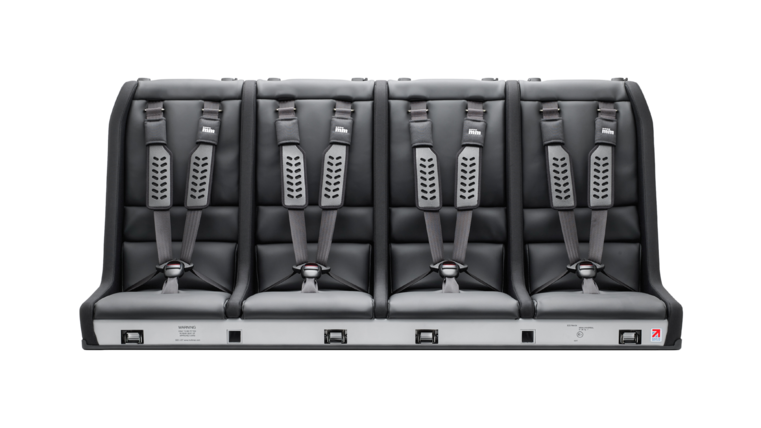
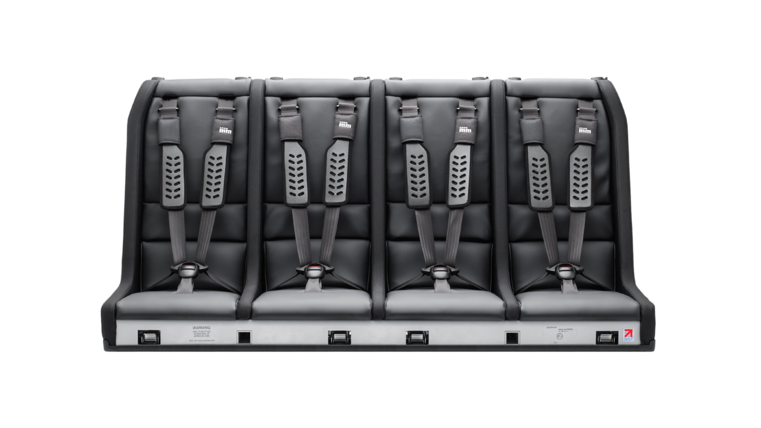
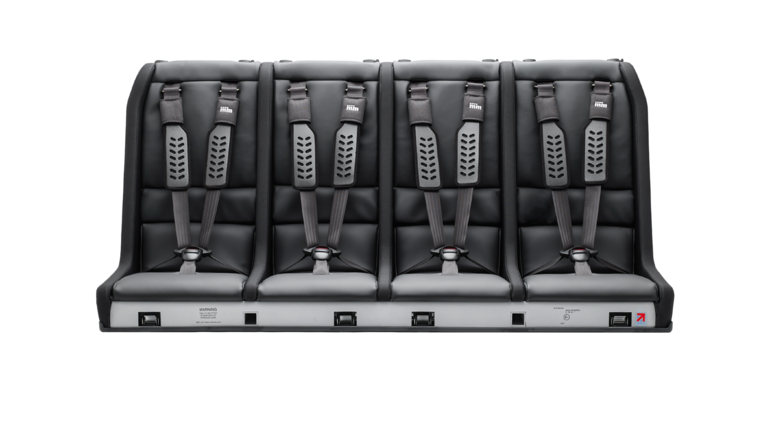
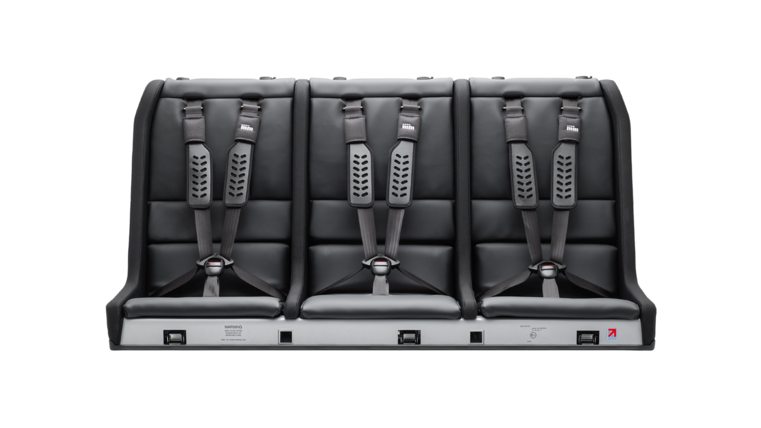
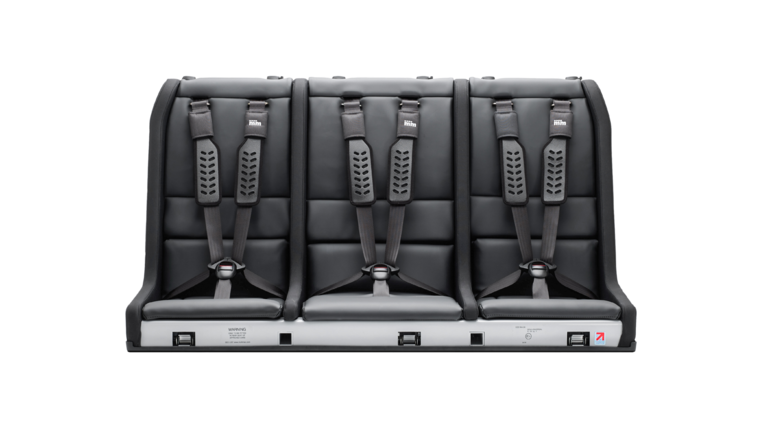
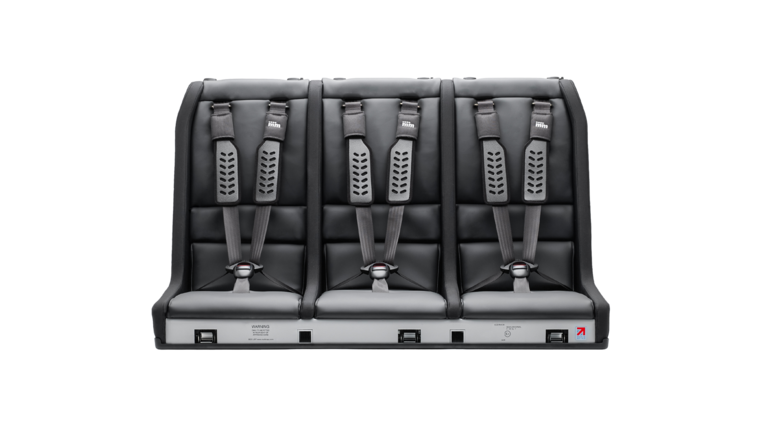
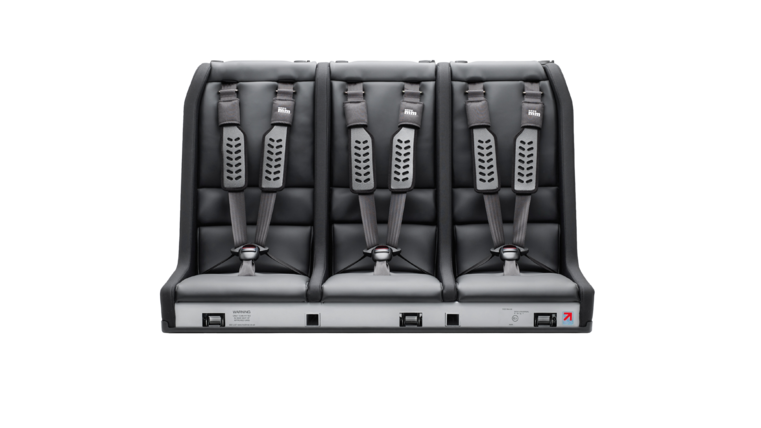
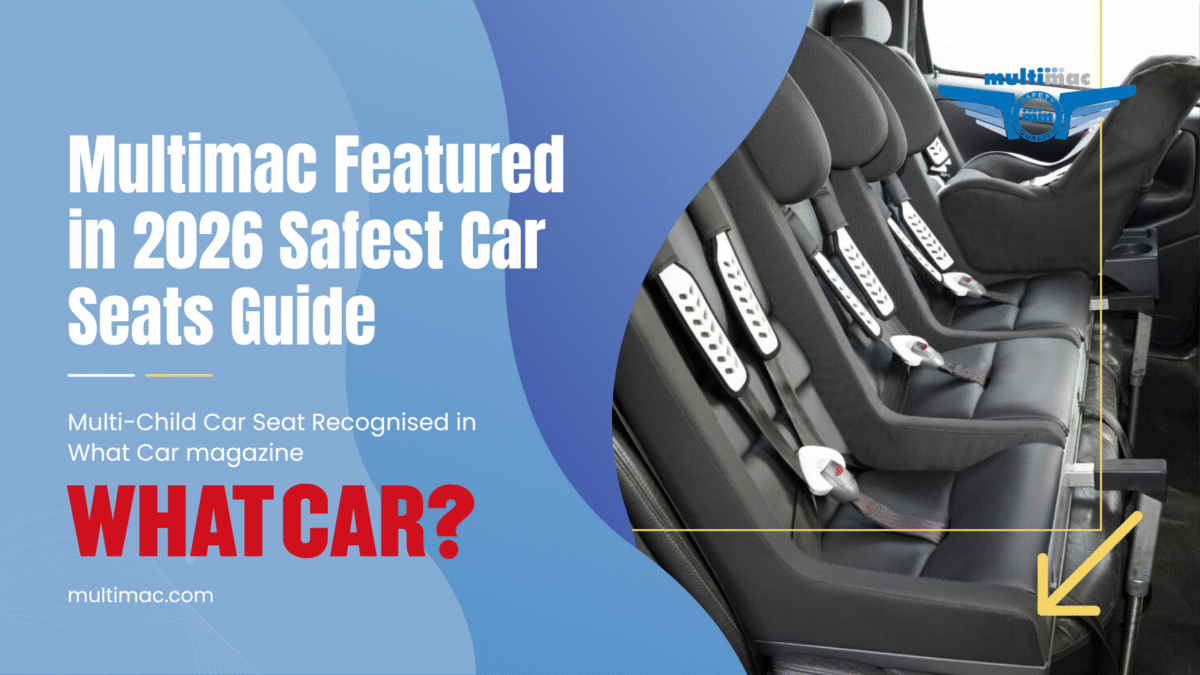
All Multimac models support rear-facing travel for babies and young children via the NEW ERF- Minimac, a rear-facing infant seat that integrates directly into the Multimac frame and covers children from birth to approximately 4 years, 19.5kg or 105cm. Up to three Minimacs can be used simultaneously in a single Multimac, which is particularly relevant for families with twins or children close in age who want all their younger children rear-facing at once.
For questions about rear-facing configuration for your family’s specific situation, the team can advise when you request a quote.
Further reading:
Statistics in this post are drawn from Axkid’s Child Safety in Cars 2025 report, Folksam’s analysis of Swedish child road fatalities 1992–2024, and the Rear Face for Safety campaign (June 2026). All are publicly available via the links above.